
Are Your Bootloaders Ready for Real-World OTA Failures?

By Jake Goellner, Senior Engineer
About the Author

Jake Goellner is a veteran embedded systems engineer with more than 25 years of experience developing hardware, firmware, IoT, and edge computing solutions across a wide range of industries.  He currently specializes in applied artificial intelligence, delivering advanced computer vision and machine learning solutions that enable high-speed automation through real-time analysis of imagery and video on platforms ranging from embedded edge processors to enterprise-scale systems.

Firmware updates are typically designed and tested within controlled, development lab environments, but products don’t operate in controlled environments. Field-deployed devices encounter power interruptions, unstable network connections, user errors, misconfigurations and countless other real-world variables that can expose weaknesses in an update strategy and create costly problems after deployment.

Those risks have become even more significant as connected devices have shifted from standalone products to long-term platforms that require ongoing maintenance, security updates, and feature enhancements.

Over the last decade, over-the-air (OTA) updates have evolved from a nice-to-have capability into a critical lifecycle requirement for connected products that are expected to receive security patches, feature improvements, calibration changes, and field fixes – all without direct physical access.

The Biggest Misconception About Bootloaders

One of the most common misconceptions I encounter is that a bootloader is simply a small utility that copies updated software into a device’s memory system. In reality the bootloader is one of the most critical components in an embedded system. It serves as the foundation for secure, reliable firmware updates and system recovery.

Another misconception is that dual-bank flash or an A/B partition memory layout automatically makes the system fail-safe. Those mechanisms help, but only when image validation, metadata integrity, boot selection, rollback policy, health checks, and power-failure behavior are designed and tested together.

When teams fail to treat the bootloader as a first-class feature and requirement during system design, they can create architectural limitations that become extremely difficult and expensive to correct later.  Firmware update reliability is now tied directly to customer uptime, cybersecurity, compliance, and warranty cost.

 Focusing only on the expected case overlooks critical risks: download the firmware image, verify its integrity, reboot, and confirm success. But field-deployed systems must gracefully handle partial downloads, interrupted writes, brownouts, watchdog resets, invalid signatures, incompatible versions, corrupt metadata, and applications that boot successfully but fail under load. Without rigorous pre-deployment verification, these edge cases become field failures—discovered by customers instead of engineers.

Common Bootloader Mistakes That Lead to Bricked Devices

The most dangerous mistake that I see all too often: overwriting a running application without a reliable fallback mechanism.

Imagine a device receiving a firmware update when communication is interrupted or power is lost. If the existing application has already been partially overwritten and the new image is incomplete, the device may be unable to boot.

This is what engineers and technologists commonly refer to as a “bricked” device.

A bricked device can no longer run its application, communicate with external systems, or receive additional updates. At that point, what was once an intelligent connected product effectively becomes a useless piece of hardware.

Another common mistake is relying on weak validation mechanisms, such as simple checksums for integrity verification, when the product requires cryptographic signing to ensure both integrity and authenticity. Some bootloaders can detect a corrupted image but lack the ability to recover to a known-good state. In other cases, rollback mechanisms exist in the architecture but are never validated through fault-recovery testing. Additional shortcomings include fragile version-management schemes, inadequately protected metadata, the absence of a clear downgrade policy, limited visibility into update status through telemetry, and test plans that verify only nominal update scenarios under ideal laboratory conditions.

Designing for Failure Before It Happens

One of the most important concepts in bootloader design is update atomicity. Simply put, an atomic update ensures a device is never left in a state where both the existing firmware and the incoming firmware are unusable.

Achieving this requires careful architecture, robust rollback strategies, and extensive validation.

At Re:Build AppliedLogix, we systematically analyze and validate failure scenarios throughout development, long before products reach the field. What happens if power is lost halfway through an update? What happens if network connectivity disappears? What happens if a user interacts with the device unexpectedly during an update installation?

These are the questions that separate resilient systems from vulnerable ones.

The True Cost of Getting OTA Updates Wrong

When update failures occur in production, the costs can escalate quickly.

Engineering teams may spend weeks attempting to reproduce intermittent failures that only occur under unique “corner-case” conditions. Meanwhile, customers experience downtime, support requests increase, and product reputation suffers.

In severe cases, companies may face large-scale replacement programs, return merchandise authorizations (RMAs), or even recall.

Investing in architecture, verification, and testing upfront is always less expensive than recovering from a failed OTA deployment.

Early Warning Signs Your Update Strategy Is at Risk

A simple test is to ask your engineering team what happens if power is lost during any of the phases of an update.

If there isn’t a clear answer, that’s a warning sign.

Another concern is vague rollback behavior. If recovery depends on manual intervention, complex procedures, or undocumented processes, the system likely hasn’t been fully validated for real-world conditions.

  • How is the image authenticated?
  • How are signing keys protected?
  • What prevents downgrades or incompatible firmware?
  • How does the application prove the new image is healthy?
  • What happens if the health check fails?
  • What telemetry is available during fleet rollout?
  • How is recovery handled if a device cannot complete an update?

If any of those questions are hard to get answers to, you probably don’t have a reliable update strategy with predictable, well-tested recovery paths.

How We Approach Fail-Safe Bootloaders at Re:Build AppliedLogix

Our philosophy is straightforward: bootloaders deserve the same level of engineering rigor as any other mission-critical feature.

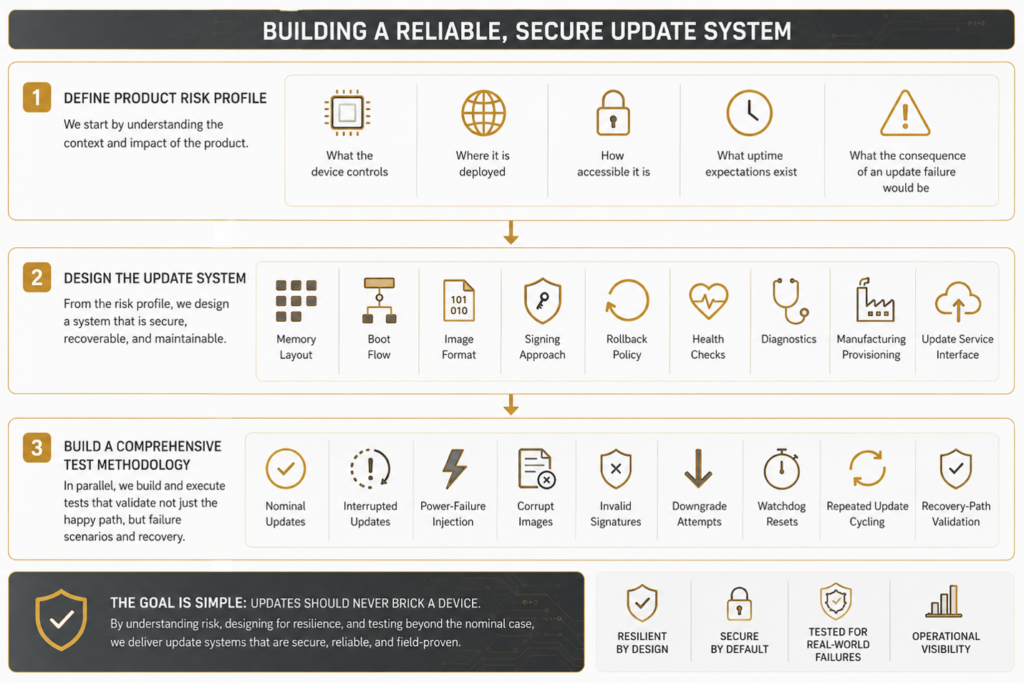
We start by defining the product risk profile:

  • What the device controls
  • Where it is deployed
  • What the device controls
  • Where it is deployed
  • How accessible it is
  • What uptime expectations exist
  • What the consequence of an update failure would be

From there, we design the complete update architecture with failure recovery in mind from the beginning—including memory layout, boot flow, image format, signing approach, rollback policy, health checks, diagnostics, manufacturing provisioning, and update service interface.

In parallel, we build a comprehensive test methodology that includes nominal updates, interrupted updates, power-failure injection, corrupt images, invalid signatures, downgrade attempts, watchdog resets, repeated update cycling, and recovery-path validation. We intentionally create communication interruptions, power disruptions, and unexpected operating conditions to verify system behavior under realistic failure modes.

The goal is simple: identify and eliminate weaknesses in the lab rather than discovering them in a customer’s hands.

This work requires more than embedded coding. It requires systems thinking, hardware awareness, firmware discipline, cybersecurity awareness, manufacturing understanding, and rigorous verification. We help clients make the right architectural tradeoffs early, then validate those tradeoffs with testing that reflects real field conditions.
The Impact of AI on Embedded Security

The rapid advancement of AI introduces new considerations and challenges for embedded systems.

As AI-powered tools become more effective at discovering vulnerabilities, engineering teams and manufacturers must assume that malicious actors will have increasingly sophisticated capabilities.

This makes secure boot processes, firmware validation, authentication mechanisms, and update integrity more important than ever.

The organizations that proactively address these risks today will be far better positioned for the connected products of tomorrow.

Final Thoughts: Treat the Bootloader as a First-Class Required Feature

 Every connected device will eventually need an update. The only question is whether your strategy will handle field conditions gracefully—or fail spectacularly when it encounters them.

A robust, fail-safe bootloader isn’t just an engineering detail. It’s a critical business asset that protects customers, preserves brand reputation, reduces support costs, and enables long-term product success.

When organizations prioritize bootloader architecture from the start, they build products that can evolve, recover, and remain secure throughout their lifecycle.

Frequently Asked Questions

What is a fail-safe bootloader?

A fail-safe bootloader is a bootloader architecture designed to ensure a device can recover from firmware update failures. It provides mechanisms such as rollback capabilities, image validation, and recovery modes to prevent devices from becoming unusable if an update is interrupted or corrupted.

Reducing risk starts with designing OTA updates and bootloaders as critical system components rather than implementation details. A robust update strategy should include rollback mechanisms, recovery paths, validation processes, and testing under real-world failure conditions.

Failed updates can lead to device downtime, increased support costs, warranty claims, product returns, emergency engineering efforts, and damage to customer trust. In large deployments, even a small update failure rate can have significant operational and financial impacts.

Ask your development partners to explain what happens when power is lost, connectivity is interrupted, or an update fails midway through deployment. A strong partner should be able to clearly describe recovery mechanisms, rollback procedures, and validation processes for each failure scenario.

Products designed for long-term support should include secure OTA update capabilities, firmware recovery mechanisms, fleet monitoring, cybersecurity protections, and a clear strategy for maintaining devices throughout their operational lifecycle.

Common indicators include unclear recovery procedures, dependence on manual intervention, limited visibility into update status, and an inability to confidently explain how devices recover from power loss, communication failures, or corrupted updates.

Organizations should go beyond standard functional testing and incorporate fault-injection testing, power interruption testing, network disruption scenarios, and other real-world conditions into their verification process to uncover potential failures before deployment.

Have a project in mind?

Fill out the form below and someone from the Re:Build AppliedLogix team will be in touch with you shortly. 

Let’s Connect​

Looking to connect with an experienced team?

Look no further than Re:Build AppliedLogix! We are excited to connect with you.